
Notes on the Universal Commerce Protocol.
If you run an online store, you already know the headache of being everywhere. You want your products to appear on Google Shopping, social media, price comparison sites, and marketplaces. But each platform requests your data differently, with different feeds that need constant updating to ensure accurate pricing and stock levels.
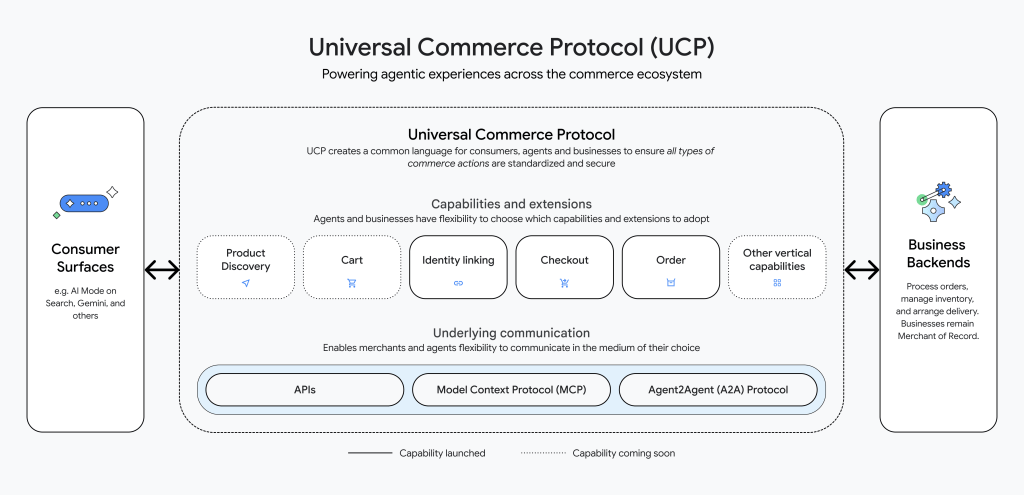
To solve this chaos, Google and other industry leaders have presented the Universal Commerce Protocol (UCP). In this article we explain, without technical jargon, why this protocol will mark a turning point for your digital business.
Go for it!

What exactly is the Universal Commerce Protocol?
Imagine that, until now, to sell in five different countries, you had to learn five different languages—complicated, right? The Universal Commerce Protocol is, so to speak, the "Esperanto" of e-commerce.
It is an open standard that allows any platform (search engines, social networks or AI assistants) to perfectly understand what you sell, at what price and if you have stock, simply by "reading" the information directly from your own website.
The end of the "dictatorship" of manual catalogs
Currently, most e-commerce businesses rely on exporting catalogs (the well-known XML or CSV files). This creates several problems:
- Outdated: Sometimes you change a price on your website and the platform takes hours to reflect it.
- Technical costs: You need external tools or programmers to make the data "fit" in each site.
- Errors: If the data is not accurate, your ads may be rejected.
The Universal Commerce Protocol eliminates these intermediaries. By using a common data structure, platforms can extract information in real time. If you change something in your store, the whole world finds out instantly. It's that simple.
Why should this interest you as a manager or owner of an online store?
Although the name sounds technical, its benefits are purely commercial:
1. Saving time and money
You no longer need to set up complex integrations for every new sales channel that emerges. With the Universal Commerce Protocol, your store is already "ready to talk" to any platform that adopts the standard.
2. Greater accuracy and fewer rebounds
Nothing frustrates a customer more than clicking on an ad only to find the product is out of stock or the price has gone up. By providing direct and seamless communication, consistent data dramatically improves buyer confidence.
3. Prepared for the AI Era
We are entering the era of AI-powered shopping assistants. These assistants need structured and clean data to recommend your products. The Universal Commerce Protocol is the foundation upon which these new technologies can efficiently find and display your catalog.
Subscribe to our newsletter.
Get the latest insights on digital solutions, industry trends, expert articles, and upcoming events.
How to start a conversation with the development team to implement the Universal Commerce Protocol in your online store?
For a business owner, talking to "the IT people" sometimes feels like an expedition to another planet. However, to implement the Universal Commerce Protocol (UCP), you need clear answers about your data infrastructure.
Here are some key questions you should ask yourself to ensure your store doesn't fall behind, translated from "technical language" to "results language":
- Regarding the current state: "How well is our data structured with Schema.org?" The UCP is based on the idea that the web "speaks" in a structured way.
Why ask this?: If your website already uses Schema.org in an advanced way (that is, if Google already understands what a price and a size are without help), you're already halfway there. If not, this is the first mandatory step. - About the platform: "Does our platform (Shopify, PrestaShop, Magento, WooCommerce...) already support native integration with UCP?"
Why ask this?: Many e-commerce platforms are releasing modules or updates to adapt to this Google standard. It's better to activate an existing feature than to pay to program something from scratch. - Regarding accuracy: "How quickly are stock and price changes updated in our JSON-LD?" JSON-LD is the code format preferred by the UCP.
Why ask this?: The purpose of the UCP is real-time synchronization. If you change a price for a last-minute offer, the development team must confirm that this change is instantly reflected in the page's code so that external platforms see it immediately. - About automation: "Can we reduce our reliance on manual Merchant Center feeds with this?"
Why ask this?: The UCP aims to eliminate the need to manually upload XML or CSV files. Ask them if they can configure your site so Google can "read" your catalog directly. Fewer manual processes mean fewer errors and lower maintenance costs. - Regarding performance: "Will the implementation of the protocol affect loading speed (Core Web Vitals)?"
Why ask this?: Adding more layers of data can sometimes slow down a website if done incorrectly. As the site owner, you want your store to be "readable" by AI, but above all, you want it to remain fast for your human customers.
Pro Tip
If they respond with a lot of complex acronyms, ask them to explain it with an analogy. A good development team should be able to confirm whether your current architecture is compatible with open standards or if you need to clean up your data beforehand.
The future: A more open market
The best thing about this protocol is that it's open. This means it doesn't belong to a single company, but rather it's a community effort to make online commerce more democratic. Whether you're a small artisan shoe brand or run a large retailer, the Universal Commerce Protocol (UCP) allows you to compete on a level playing field.
Conclusion
The Universal Commerce Protocol is not just a technical improvement; it's a declaration of intent toward a more agile and less fragmented online commerce. For business leaders, it means less operational friction and more time to focus on what truly matters: sales strategy and customer satisfaction.
If you want your online store to be ready for what's coming from 2026 onwards, it's worth closely following the implementation of this new standard.
Do you have any ecommerce projects in mind? Contact us here, We'd be happy to talk about your business.
Do you need to develop a digital solution for your business?
Contact us today here to start an incredible project together.

Digital Marketing Manager at Orienteed.
I lead the planning and execution of Orienteed's digital marketing strategy with a fantastic team, making sure it aligns with our strategic goals and drives business growth. I'm really into inbound marketing, web design, and creating content that matters.
I wrote the book: "How to Create a Profitable Blog Today."
"Marketing is about values. It’s a complicated and noisy world, and we’re not going to get a chance to get people to remember much about us. No company is. So we have to be really clear about what we want them to know about us."
—Steve Jobs