
In an increasingly hectic and wild digital environment, where products and prices tend to become the same, customer experience (Customer Experience or CX) has become the true differentiating factor. It is no longer enough to have a good product or a functional website: sustained success in digital commerce depends on offering memorable, fluid and personalized experiences at each point of contact with the customer.
In this article we will share what Customer Experience CX is all about, why it has become a standard and what you should do to make your digital business successful when interacting with your customers.
Go for it!
What exactly is Customer Experience?
Customer Experience encompasses all the interactions that a person has with a brand throughout their journey as a customer. From discovering the product until the moment after the purchase, including browsing the online store, the payment process, delivery of the order or after-sales service.
It's not just about making everything "work well." It's about designing experiences that generate trust, emotional connection and long-term loyalty. In fact, many industry experts talk about the Wow effect!, when it comes to truly unique experiences.
Why has CX become the new standard?
Today, consumers are more demanding: They expect immediacy, personalization and consistency across all channels. If they don't find it in one brand, they will go with another. And they will do it quickly.
Loyalty is no longer earned by price alone: Brands that offer better experiences retain more customers, increase the average ticket and receive better recommendations.
It is an old acquaintance, but digital word of mouth has more impact than ever: A bad experience is shared on networks, forums or public reviews, affecting the brand's reputation in real time.
Key Elements for an Outstanding Digital Customer Experience
1. Real-time personalization
Modern e-commerce platforms allow you to adapt navigation, products displayed or promotions according to user behavior. This increases conversion and satisfaction. At Orienteed, we have extensive experience in digital commerce, so if you need help to improve the customer experience of your business, visit this link.
2. User-centered design
A website or app must be intuitive, fast, accessible from any device and without friction. Every click counts: if something delays or confuses, the user leaves.
3. Omnichannel
The customer expects a seamless experience between physical and digital channels. What starts on social networks can end up in the physical store, or vice versa. All touch points must be connected.
4. Proactive customer service
Good service is no longer just about resolving doubts: it is about anticipating problems. Bots, live chats, proactive notifications and a good returns system are essential.
5. Frictionless logistics and delivery
The experience does not end when you pay. Order tracking, delivery times, the ability to modify or return without complications are a critical part of CX.
6. Smart use of data
Data allows us to better understand the customer, predict their needs and offer them what they are looking for before they ask for it. But they must be used ethically and transparently.
Subscribe to our newsletter.
Get the latest insights on digital solutions, industry trends, expert articles, and upcoming events.
Below are a couple of real and detailed examples of how European companies are successfully applying Customer Experience strategies in digital commerce. Each one focused on a specific sector, let's see:
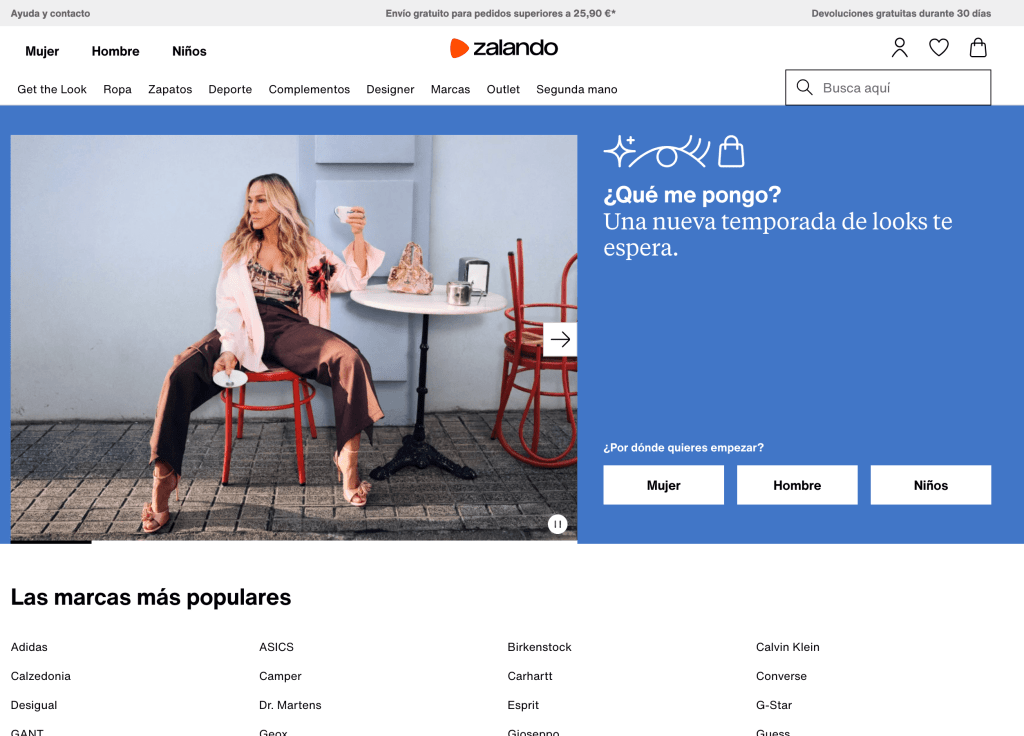
Customer Experience at Zalando (Germany), Fashion and Retail sector
Zalando, one of the main fashion marketplaces in Europe, has made Customer Experience the center of its growth strategy. How do they do it?
Keys to your customer experience:
- Frictionless logistics: Free shipping and returns in almost all European countries, with pre-printed labels and home collection.
- Hyper personalized recommendations: They use AI to offer complete outfits and size suggestions based on previous purchases, returns and style preferences.
- Intuitive and connected app: The experience between the web and mobile app is fluid, fast and coherent. In addition, they integrate editorial content (such as fashion magazines) directly into the app, generating engagement beyond the purchase.
- Fast, multi-channel customer service: Chat, email, telephone, WhatsApp... all from a clear and accessible interface.
Result: Zalando has improved its conversion rate and significantly reduced erroneous returns thanks to its smart sizing system, in turn improving customer satisfaction.
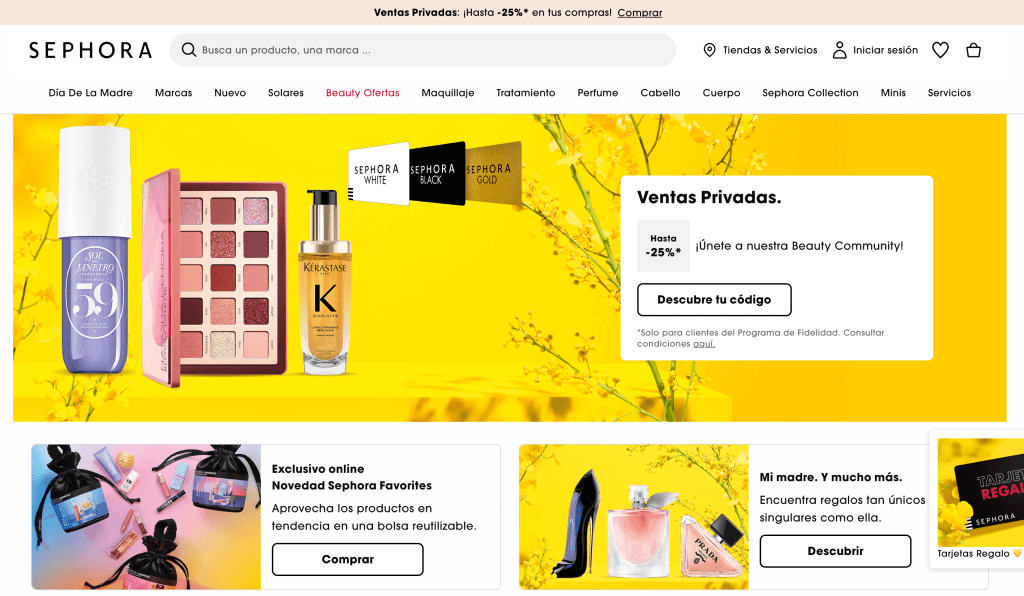
Sephora and the adaptation of its experience in Europe, Cosmetics and Beauty sector
Sephora, present in much of Europe, has been able to adapt its digital experience to replicate – and in many cases improve – the advice experience it offered in a physical store.
Keys to your customer experience:
- Virtual consultants and online product testing: Using augmented reality technologies, users can try makeup products from the web or app, seeing how they would look on their face in real time.
- Personalized beauty profile: By creating an account, customers can set their skin preferences, style, and goals. This allows you to receive personalized recommendations, replenishment reminders and specific tutorials.
- True omnichannel: You can buy online and pick up in store in less than 2 hours. Additionally, if a product is not available online, the platform shows which physical stores nearby it is available in.
- Experiential loyalty program: “Sephora Beauty Pass” offers points not only for purchases, but for interactions, reviews or sharing on networks. This generates an active and loyal community.
Result: Thanks to this combination of technology, personalization and omnichannel, Sephora has increased the purchasing frequency of its most loyal customers and has improved the average online ticket.
How to start improving Customer Experience CX?
Well, now that you know what CX is, its key elements and even a couple of emblematic examples, you may be wondering how to improve in your own business. These are some of the ideas you could implement:
- Map the customer journey: Identify all points of contact with your brand. Analyze where there are frictions or critical moments. Do you need help with this? You can use ValidoAI, to test the user experience of your site. It has a free plan.
- Actively listen: Surveys, feedback, web behavior analysis... All the information is useful to know what to improve.
- Involve the entire team: CX is not just a marketing or IT thing. The entire organization must work customer-oriented. This is undoubtedly something key in the culture of modern organizations.
- Constantly iterate: The CX is not designed once and that's it. It is a living process that evolves with consumer habits. Therefore, it requires being permanently updated with it.
Conclusion: Experience is everything
In digital commerce, customer experience has gone from being a “plus” to being the standard. Brands that understand this and act accordingly not only sell more, but also build lasting and differentiated relationships with their customers.
Investing in Customer Experience is not a fad: it is a key strategy to lead in the present and future of digital commerce. If you need help, at Orienteed we will be happy to hear about your business. For this, contact us here.
Do you need to develop a digital solution for your business?
Contact us today here to start an incredible project together.

Digital Marketing Manager at Orienteed.
I lead the planning and execution of Orienteed's digital marketing strategy with a fantastic team, making sure it aligns with our strategic goals and drives business growth. I'm really into inbound marketing, web design, and creating content that matters.
I wrote the book: "How to Create a Profitable Blog Today."
"Marketing is about values. It’s a complicated and noisy world, and we’re not going to get a chance to get people to remember much about us. No company is. So we have to be really clear about what we want them to know about us."
—Steve Jobs