
One of the main advantages of having an ecommerce site is the ability to create your own email list. It's the kind of information that no one else has and that gives you a significant advantage over the competition by building relationships and keeping your customers interested. With the growth of online stores, your ecommerce email marketing strategy can play a fundamental role in expanding your business.
Various industry statistics indicate that the baseline open rate is 21%, and that 2.56% of those opens click through to the website. What is quite interesting and a crucial factor in eCommerce marketing is that 55% of emails are opened on mobile devices, making mobile responsiveness one of the most important factors in determining success. of the email.
Once you've established this, you don't have to settle for the benchmark, right? In this article we share a complete email marketing guide for ecommerce with actions you can take to obtain successful results.
Let's start!

What is email marketing for ecommerce?
Email marketing is one of the most useful tools, especially for companies doing ecommerce today, as it allows them to connect with customers in a personalized way at a very low cost.
Ecommerce email marketing, as the name suggests, is essentially a powerful email-based strategy to promote an online store's products and services to potential and existing customers. Emails are a very popular form of online communication, making them effective, efficient, affordable and cost-effective.
Email marketing for ecommerce can be as simple as sending an email to a customer who added items to the cart but left without making a purchase and can be as complicated or misleading as connecting multiple campaigns to increase sales. How you use your email marketing campaigns is completely up to you. It depends on your business goals, marketing goals, audience, business growth, etc.
The bottom line here is that email marketing is basically about fostering and building 1-on-1 trust, a strong and long-lasting relationship with customers, which works wonders.
Your emails influence the way your customers feel about your brand when they shop at your store, whether online or offline. Therefore, you need to connect with your customers and keep them engaged with your email marketing strategy. Otherwise, with tons of emails bombarded every day by different companies, you can lose your customers to an ocean of distractions and competitors.
From PPC ads to promotional emails and newsletters, there are many ways to use digital marketing to generate sales for your online store. However, emails, being direct – if you will intimate – communication from the brand, are a more profitable and specific way to reach your customers. Additionally, you can easily get a complete picture of your email marketing performance, make adjustments, and therefore improve effectiveness.
Key metrics to track for eCommerce email marketing campaigns include but are not limited to:
- Delivery rate
- Open rate
- Clicks
- Bounce rate
- Conversion rate
- Subscriptions
- Unsubscription rate
Grow your online store with email marketing
For the growth of an ecommerce business, it is essential to optimize comprehensive email marketing campaigns according to the objectives, key performance indicators and the most important metrics. Although you can also use social networks to grow your business, email marketing is, without a doubt, the best digital marketing tool to contribute to customer acquisition.
This is because brand awareness, first impressions, and the ability to capture the user's attention can be best leveraged through email marketing. However, some things you can do to avoid being flagged as spam include:
- Don't buy email lists
- Using opt-in forms to collect emails
- Provide an option to unsubscribe
- Creating audience segments
- Do not use spam phrases
- Spread quality content
Now that we've covered exactly what ecommerce email marketing is, why it's important, and the key metrics to monitor campaigns, let's talk about the practices, types, and relevant elements of this type of strategy. Let's look at all the elements needed when designing an email that increases conversion and sales.
Subscribe to our newsletter.
Get the latest insights on digital solutions, industry trends, expert articles, and upcoming events.
Why are email marketing campaigns for ecommerce the key to success?
The statistics mentioned below probably explain why email marketing is essential for your ecommerce success:
- More than 99% of consumers check their inbox every day
- More than 80% of retailers consider email marketing to be one of the most cost-effective ways to retain customers.
- 59% of consumers believe that marketing emails influence their purchasing decisions.
Email marketing not only builds brand awareness and credibility, but also tends to maintain relationships with clients.
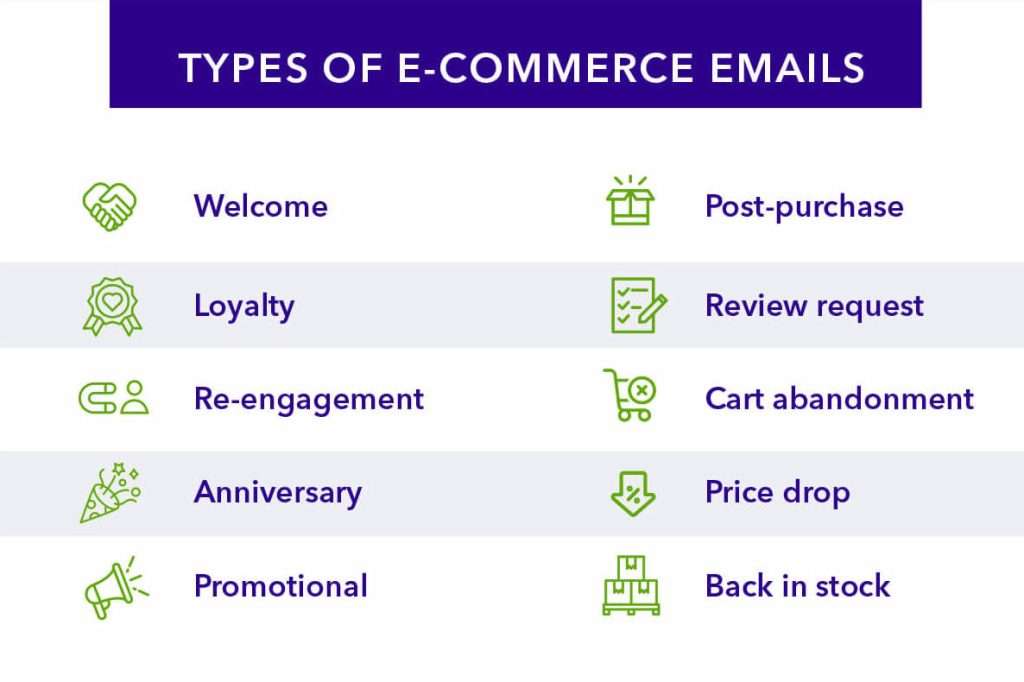
The types of emails for ecommerce that you can send
Below is a list of ecommerce emails that you can include in your marketing strategy:
1. Welcome emails
A welcome email is the first step in building a long-term relationship with a customer. It can be a defining moment, so the challenge is to make sure your email is purpose-driven, excites the user, and initiates action. If your welcome email is nothing more than a registration receipt, you're doing it wrong.
To begin with, the fundamental goal of this type of message should be to show existing and new subscribers what your business is really about, because this is the time when it receives more attention than you will ever receive from a user again.
While a simple, clean, and aesthetically pleasing email template is a great place to start, it's a good idea to go beyond the rules and reward new users in some way for signing up.
2. Loyalty emails
Although customer loyalty is not built overnight or with a single campaign, developing frequent and well-targeted email marketing campaigns that aim to encourage the loyalty of existing and new subscribers is not a bad idea either, since that increases customer lifetime value.
You've probably heard of premium membership programs, right? Well, these are the most common types of loyalty programs that brands use to ask users to sign up for an “exclusive” email list that gives them early access to special offers, product launches, and event invitations. specials.
3. Reactivation emails
In the case of ecommerce platforms, there are usually a large number of “disengaged subscribers” who have not visited your store, purchased from it, or opened your emails in a long time. They are familiar with your brand and its products or services, but their behavior is peculiar and cannot be solved.
Therefore, they tend to be a warmer audience than strangers. In this sense, suggestions to re-engage with offers that are too good to pass up are an effective way to get them to re-engage.
Whether it's a discount offer or a contest, be sure to highlight your incentive in a way that won't go unnoticed. Just a suggestion, make it personalized and make the client feel special and loved. No one can leave this out, for sure!
Use phrases like “We miss you!” or “Please come back!” to remind them of their past relationship with your brand.
4. Anniversary emails
Who doesn't like to feel special?
Especially if a company remembers your birthday or anniversary, it takes it to a whole new level. Personalized wishes with coupons, discounts, rewards, and special offers are very effective in generating customer engagement and building trust.
It's pretty easy: just ask for the date of birth or anniversary date when someone subscribes to your email list without asking for any additional information. By offering incentives based on customers' past interactions, you can encourage them to make purchasing decisions based not only on price, but also on shared values, engagement, and the overall experience of your brand.
5. Promotional emails
Every day we receive tons of promotional emails, right?
From my own experience, most of these messages tend to be less strategic and systematic. For example, we all receive dozens or hundreds of boring promotional email messages every month, most of which no one dares to open. This is a disaster. You have to think carefully about these campaigns.
Unlike other transactional emails that inform customers about their order or account information, promotional emails are generally intended to convert email subscribers into customers, and customers into brand advocates.
Brands often use these emails to promote their products, services, offers, and campaigns. For this same reason, you should pay a little more attention to these campaigns.
6. Post-purchase emails
Investing in a new customer requires much more effort and money than retaining one. Therefore, returning customers are considered a great way to increase a company's return on investment.
One of the main advantages of creating a post-purchase campaign is that it facilitates fluid communication with customers. Instead of interrupting someone's busy schedule with an annoying phone call (which also eats up a lot of productive time), emails are a viable follow-up option.
Any customer's first purchase marks the foundation of the relationship between retailer and customer. Therefore, it is important to send post-purchase emails to first-time buyers to build loyalty and turn them into loyal customers.
Post-purchase emails not only act as a way to get feedback from customers, but also as a way to promote additional products and services that they might be interested in.
7. Review application emails
Testimonials and reviews are a great way to build trust with customers, especially for those who are reluctant to make a purchase. It puts them one step ahead in the sales funnel.
83% of people find new products based on customer reviews and 4 in 5 American consumers read reviews before making a purchasing decision because testimonials help build brand reputation, they bring a lot of credibility to your company and provide the type of social proof needed to influence consumer behavior.
Not only are reviews a great way to get useful information about your product and service, but they also send the message that your brand cares about customers. Therefore, customer feedback emails go a long way in establishing a relationship between your brand and the customer.
8. Shopping Cart Abandonment Emails
The average shopping cart abandonment rate varies between 60% and 80%. However, one of the most popular ways to recover lost revenue is to use an abandoned cart email to follow up with buyers.
Abandoned cart emails are extremely conversion-oriented messages that move recipients and prompt them to take action. These types of emails are incredibly important for holiday-oriented emails, such as Christmas email campaigns or Thanksgiving, Black Friday marketing campaigns, etc.
9. Price reduction emails
The success of all ecommerce transactions depends largely on pricing. A profitable marketing strategy involves the seller understanding the competition, as well as the decision-making processes of potential buyers, to create prices that incentivize purchases.
Since the price of a product is still a crucial factor in ecommerce, why can't we use it to drive more sales?
Price reduction alerts inform shoppers about discounts on their favorite products outside of a formal sale. The active email lets everyone who has shown interest in the product know that it is now cheaper.
The principle of operation is simple. The browsing data of buyers who have chosen to receive your email marketing is captured and stored. When you enter a price into your eCommerce system, the email is automatically activated and sent.
10. Emails with return to stock information
There are many reasons why your products may be out of stock, including increased demand during certain seasons, such as Halloween, Thanksgiving, New Year's, and Christmas. The effect can be very frustrating for buyers, who expect to be able to buy what they want and when they want it.
The damage caused by lack of stock can be long term. Not only is a sale lost, but the customer can buy from the competition and establish a satisfactory relationship with them.
But marketers can turn an out-of-stock product into a positive customer interaction.
Sending an email that the product is back in stock presents an opportunity to recoup potential lost revenue, keep customers engaged with your brand, and ultimately delight shoppers by providing them with the product they want.
Email marketing for ecommerce: best practices
Well, now that we know what the most important types of email are in digital commerce, let's look at the best practices so you can boost your strategy:
- Use templates Fully responsive email design templates to make them easy to read on any device. Most email marketing platforms, usually have template libraries ready to use. Make sure links are easy to follow.
- Get to know your customers better by performing A/B testing. You will be able to discover your customers' needs so that email campaigns are more effective and sales-oriented.
- One of the most useful email marketing methods for an ecommerce business to build customer loyalty and develop its brand image is to send exclusive offers with additional discounts or reward points.
- Notify your customers about important announcements, such as sales, holiday sales, end-of-season discount offers, special offers, etc., to encourage them to visit your website.
- Send emails based on behaviors, highly personalized and relevant to each user. Some examples of these emails include shipping status emails, order confirmation, review request emails, etc.
- Introduce a referral program that can generate new potential clients and foster loyal relationships. People tend to trust what their friends and colleagues recommend, so it's a good opportunity to promote your brand.
Now is your turn!
As we have seen, most potential customers continue to check their email inbox every day. They even do it several times a day from their mobile devices. Perhaps this is the main reason to develop an email marketing strategy for ecommerce, which helps you build loyalty, retain and create a close relationship with your customers.
Simply by taking control of the right messages, and sending them in a personalized way at the right times, you will surely be helping to increase your sales and develop the reputation of your business.
Do you need to develop or migrate your ecommerce?
Contact us today here to start an incredible project together.

Digital Marketing Manager at Orienteed.
I lead the planning and execution of Orienteed's digital marketing strategy with a fantastic team, making sure it aligns with our strategic goals and drives business growth. I'm really into inbound marketing, web design, and creating content that matters.
I wrote the book: "How to Create a Profitable Blog Today."
"Marketing is about values. It’s a complicated and noisy world, and we’re not going to get a chance to get people to remember much about us. No company is. So we have to be really clear about what we want them to know about us."
—Steve Jobs