
Global beauty and cosmetics ecommerce will surpass $580 billion by 2027, with the online channel already representing 21% of total sales (McKinsey, 2023). The brands that convert best in this sector combine augmented reality, AI-driven personalization, influencer strategy, and subscription models within a coherent omnichannel experience.
In this article we share the most important trends you should watch and consider for your commercial activity this year, if your brand is part of one of the most powerful industries in today's global economy.
This article was first published on July 18, 2024, and has been updated in May 2026.
Why Is Beauty Ecommerce Different from the Rest of Online Retail?
Beauty brands face a challenge in the digital environment that other sectors do not: their products are bought with the senses. The texture of a cream, the exact shade of a lipstick, or the fragrance of a perfume are decisive purchase factors that no screen can communicate natively.
This is precisely the starting point Orienteed analyzes when working with clients in the beauty sector: it is not just about having a well-built online store — it is about creating digital experiences that substitute, or surpass, physical contact with the product.
"In beauty, online conversion is not won with more traffic — it is won by eliminating sensory friction. Every technology that brings the product closer to the customer in their real context is a direct lever on the cart." — Francesco Schettini, CEO of Orienteed
The good news is that in 2026 the tools to do this are more accessible than ever. The trends described below apply to both emerging brands and established retailers, regardless of whether they operate on Adobe Commerce, Shopify Plus or a headless architecture.
The Beauty Industry in Numbers: Why This Channel Is Worth Investing In
The global beauty market reached $430 billion in 2022 and is projected to reach $580 billion by 2027, with an annual growth rate of 6% (McKinsey Beauty Market Report, 2023). Within that total, ecommerce has grown from representing 8% of sales in 2015 to 21% in 2023, with a projected share of 26% by 2027.
| Market | Total beauty sales 2027 (projection) | Online sales 2027 (projection) | % online channel |
|---|---|---|---|
| United States | 115.000 M$ | 45.000 M$ | ~39% |
| China | 96.000 M$ | 55.000 M$ | ~57% |
| India | 21.000 M$ | Expanding | Emerging market |
| Middle East and Africa | 45.000 M$ | Expanding | Emerging market |
(Source: McKinsey Beauty Market Report, 2023)
A particularly relevant data point for brands operating in Spanish-speaking markets: the online channel in China already accounts for more than 57% of total beauty sales, signaling the direction of the digital maturity curve across all markets.
Which Generation Is Redefining the Online Beauty Market?
Generation Z — people born between 1996 and 2010 — is reaching its peak purchasing power and is rewriting the rules of the beauty market. Their brand preferences are radically different from previous generations: they prioritize authenticity, inclusivity, and brand purpose over heritage or advertising budgets.
| Brand | Preference among young people (Gen Z) | Differential factor |
|---|---|---|
| Elf Cosmetics | 22% | Affordable price, inclusive positioning, strong on TikTok |
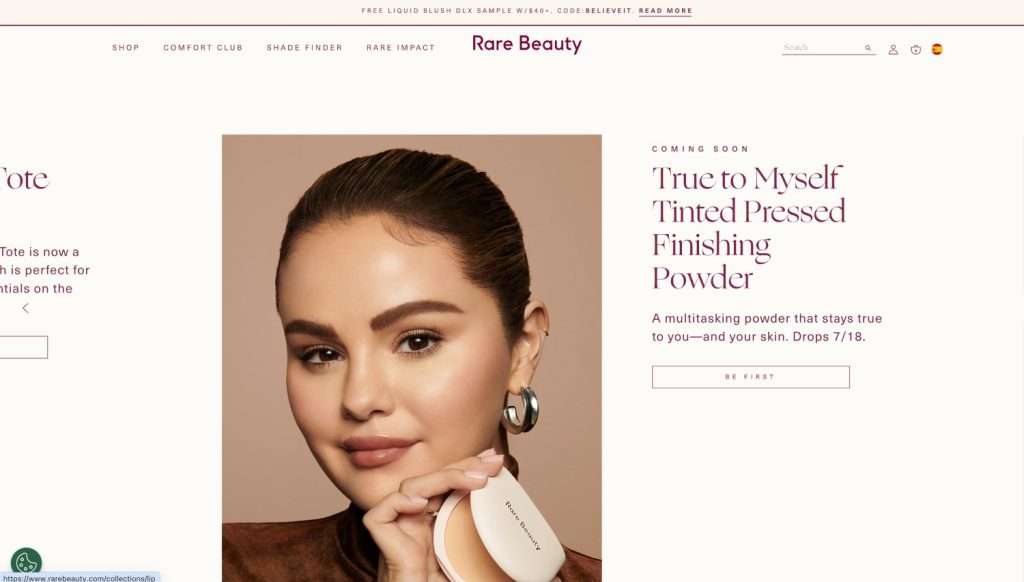
| Rare Beauty (Selena Gomez) | 11% | Mental health cause, founder's authenticity |
| Maybelline | 7% | Brand recognition + digital adaptation |
| L’Oréal | 6% | Investment in AR technology and personalization |
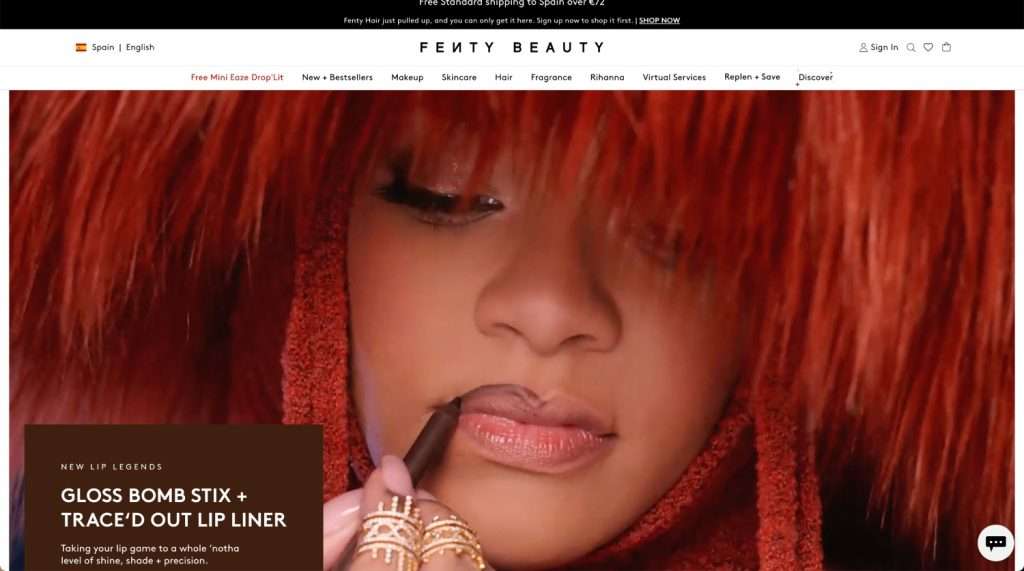
| Fenty Beauty (Rihanna) | 6% | Skin tone inclusivity as a core value proposition |
(Source: Morning Consult Brand Intelligence, 2023)
The convergence of beauty and wellness reinforces this trend: the wellness market, valued at $1.8 trillion, is growing at 10% annually, and 82% of American consumers consider wellness a daily priority (McKinsey Global Wellness Survey, 2023). Beauty brands that integrate this narrative — clean ingredients, long-term skin impact, emotional well-being — capture a disproportionate share of attention in the digital channel.
What Are the Beauty Ecommerce Trends That Will Define 2026?
The six trends with the greatest impact on conversion and loyalty in beauty ecommerce in 2026 are the following:
1. Augmented Reality (AR): Trying the Product Before Buying It
Augmented reality allows beauty ecommerce customers to virtually try on makeup and skincare products in real time, directly from their mobile camera or browser. This technology eliminates the primary online purchase barrier in the sector: the uncertainty about how a product will look on their own skin.
| AR Functionality | Impact on the funnel | Implementation examples |
|---|---|---|
| Virtual makeup trial | Reduce returns, increase time on page | L’Oréal Virtual Try-On, MAC Cosmetics |
| Skincare simulation | Increases product confidence, improves conversion | Neutrogena Skin360, Olay Skin Advisor |
| Share on social media | Generates organic UGC, amplifies brand reach | Sephora Virtual Artist, NYX |
| Interactive AR tutorials | Increase engagement and session time | Charlotte Tilbury, Benefit Cosmetics |
L'Oréal reported that users who interact with its virtual try-on tool convert at a rate 2.4 times higher than those who do not (L'Oréal Annual Report, 2023). The underlying technology (ModiFace, acquired by L'Oréal in 2018) is now available to third parties through an API, making it accessible to mid-size brands.
2. AI Personalization: From Generic Catalog to Individual Recommendation
AI personalization algorithms in beauty ecommerce analyze purchase history, declared skin tone, hair type, and browsing behavior to deliver product recommendations with high individual relevance. This personalization layer is especially critical in beauty because the "wrong product" — an incorrect foundation shade, a serum formulated for a different skin type — drives returns and destroys trust.
80% of consumers are more likely to purchase when the experience is personalized (Epsilon, 2023). In beauty, where the repurchase cycle for a product that works is very short, correctly personalizing the first recommendation has a compounding effect on customer Lifetime Value (LTV).
At Orienteed we have worked with B2C beauty platforms that integrated recommendation engines on Adobe Commerce, achieving 18–25% increases in average cart value by replacing the generic "related products" carousel with user profile-based recommendations.
3. Sustainable Beauty and Clean Beauty: From Trend to Purchase Criterion
Sustainability has moved from being a niche differentiator to a criterion for exclusion: 73% of global consumers say they would change their consumption habits to reduce their environmental impact (Nielsen Global Sustainability Report, 2023). In beauty, this translates into demand for clean formulations, recycled packaging, cruelty-free certifications, and ingredient traceability.
The natural and organic cosmetics market will grow at a compound annual rate of 9.76% through 2027, reaching $33.04 billion (Grand View Research, 2022). Brands that communicate these attributes in a verifiable and specific way in their ecommerce — not as generic claims, but with certifications, seals, and ingredient storytelling — improve both conversion and repurchase rates.
For brands operating in ecommerce, the practical implication is clear: the product page in 2026 needs to include structured, verifiable sustainability information — not just an "eco-friendly" icon.
Subscribe to our newsletter.
Get the latest insights on digital solutions, industry trends, expert articles, and upcoming events.
4. Influencer Marketing: From Macro to Micro, From Follower to Community
Influencer marketing remains the most efficient acquisition lever in beauty, but the dynamics have shifted: micro-influencers (between 10,000 and 100,000 followers) and user-generated content (UGC) now influence 42% of purchase decisions in the sector (Influencer Marketing Hub, 2023), outperforming major names in efficiency.
| Type of influencer | Reach | Average engagement rate | Strength in beauty |
|---|---|---|---|
| Mega (>1M) | Muy alto | ~1-2% | Brand launches, mass awareness |
| Macro (100K-1M) | High | ~2-4% | Seasonal campaigns, new categories |
| Micro (10K-100K) | Medium | ~4-8% | Direct conversion, specific product niche |
| Nano (<10K) / UGC | Bajo | >8% | Maximum authenticity, highly credible reviews |
(Source: Influencer Marketing Hub Benchmark Report, 2023)
61% of American consumers trust real product demonstrations more than ads or virtual demonstrations (Edelman Trust Barometer, 2023). TikTok, with its short-video format and the #TikTokMadeMeBuyIt phenomenon, has become the channel with the highest conversion velocity for mid-price beauty products.
5. Subscriptions and Memberships: Recurring Revenue and Predictable Income
Subscription models in beauty ecommerce generate recurring revenue, increase customer LTV, and create a proprietary product discovery channel. The subscription ecommerce market has grown more than 100% annually over the past five years, and one third of American consumers have at least one active retail subscription (McKinsey, 2023).
The elements that make a beauty subscription work are box personalization (the customer selects preferences or skin type), exclusivity (products or discounts not available in the general channel), and the flexibility to pause or cancel without friction. Birchbox, the pioneer of this model, demonstrated that personalizing the monthly selection and hosting community events for subscribers are the factors that most effectively reduce churn.
6. Omnichannel Strategy: Coherence Between Digital and Physical
An omnichannel strategy in beauty integrates the online store, social media, the app, and — where applicable — the physical point of sale into a seamless customer experience. The customer who virtually tried on a shade in the app should be able to find it in stock when they visit the store; the one who bought online should be able to return in-store without friction.
Glossier is the benchmark case for this model: it was born as a digital pure-player, built an online community, and opened physical stores as an extension of the brand experience — not as a separate sales channel. The result was a customer retention rate significantly above the industry average (Fast Company, 2022).
For brands operating on platforms such as Adobe Commerce, omnichannel integration requires a unified data architecture — a single customer profile fed by all touchpoints — and real-time inventory management visible across all channels.
How Should a Beauty Brand Adapt Its Platform to Improve Conversion in 2026?
Improving conversion in beauty ecommerce in 2026 requires acting on four layers simultaneously:
| Layer | Priority action | Expected impact |
|---|---|---|
| Product technology | Integrate virtual trial AR into product sheet | +2x conversion in users who interact with AR |
| Personalization | Recommendation engine based on skin profile/tone/history | +18-25% in average cart value |
| Content and trust | Verified UGC + reviews with photos + micro-influencers on PDP | Reduced checkout abandonment rate |
| Business model | Customizable subscription with onboarding by skin type | Increased LTV and reduced CAC in repurchase cycles |
Now is your turn!
At Orienteed we help beauty brands and retailers implement these layers on Adobe Commerce platforms and headless architectures. If your beauty ecommerce needs to make the technological leap — from AR integration to data architecture for personalization — contact our team for a no-commitment initial assessment.
Do you need to develop or migrate your ecommerce?
Contact us today here to start an incredible project together.

Digital Marketing Manager at Orienteed.
I lead the planning and execution of Orienteed's digital marketing strategy with a fantastic team, making sure it aligns with our strategic goals and drives business growth. I'm really into inbound marketing, web design, and creating content that matters.
I wrote the book: "How to Create a Profitable Blog Today."
"Marketing is about values. It’s a complicated and noisy world, and we’re not going to get a chance to get people to remember much about us. No company is. So we have to be really clear about what we want them to know about us."
—Steve Jobs